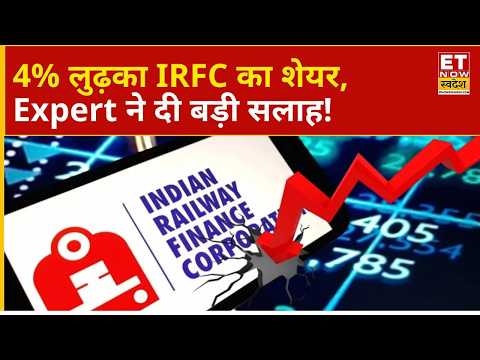
Shares of Indian Railway Finance Corporation (IRFC) dropped more than 5% during intraday trading today, June 24, 2026, following the Government of India's initiation of a discounted Offer for Sale (OFS) designed to offload up to a 2% equity stake.
The Mechanics of the Equity Dilution
The Department of Investment and Public Asset Management (DIPAM) executed the OFS mechanism on the Bombay Stock Exchange (BSE) and National Stock Exchange (NSE) this morning. The base offer consists of 13.07 crore equity shares, representing a 1% stake, with an identical greenshoe option to absorb oversubscription. The floor price was fixed at ₹91 per share, representing a 7.77% discount to Tuesday's closing price of ₹98.67.
Consequently, the stock immediately corrected to align with the discounted floor price, hitting an intraday low of ₹93.41. The non-retail bidding window opened today, while retail investors gain access on June 25. Prior to this transaction, the government held an 84.65% stake in the dedicated railway financing arm.
The Sovereign Liquidity Incentive
The immediate financial implication of this OFS reveals a structural wealth transfer mechanism. By pricing the shares at a steep discount, the government guarantees the absorption of 26.14 crore shares to raise approximately ₹2,300 crore for the national exchequer. This maneuver directly serves the Centre's FY27 divestment targets.
Unlike private sector capital reallocation—seen in events like the
Oracle restructuring happening right now—the IRFC equity dilution serves strictly to plug sovereign fiscal deficits rather than fund internal corporate innovation. Institutional investors bidding today acquire a zero-non-performing-asset (NPA), sovereign-backed financial instrument at a markdown. Conversely, retail shareholders, who currently hold a 9.68% stake, absorb the immediate portfolio depreciation caused by the sudden supply-side shock.
Fundamental Disconnect in Valuation
Operational Stability Amidst Market Volatility
The market reaction contradicts the underlying financial stability of the corporation. According to
BSE exchange filings, IRFC reported a net profit of ₹1,684 crore for the quarter ending March 2026, maintaining flat year-over-year profitability while quarterly revenue increased 9% to ₹7,336 crore.
IRFC operates on a cost-plus leasing model with the
Ministry of Railways, ensuring guaranteed margins and eliminating credit risk. The current price drop is entirely disconnected from operational performance. It is a mechanical adjustment to the sudden influx of discounted equity mandated by the
Department of Investment and Public Asset Management. Institutional buyers capitalize on the retail panic, securing long-term dividend yields at a lower entry point, while the government successfully monetizes its asset without altering the fundamental business structure.