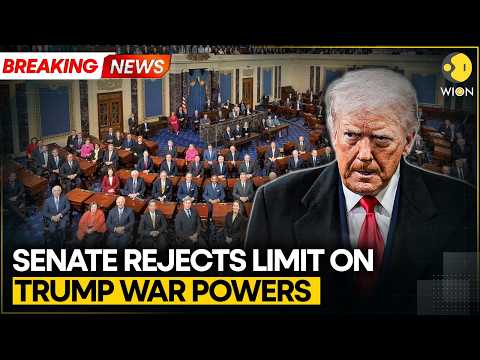
The U.S. Senate just passed a historic War Powers resolution today to halt military action in Iran, setting up a massive constitutional showdown right now on the President's desk. As the bill heads to the Oval Office following a dramatic 24 hours on Capitol Hill, the burning question is whether the President can legally veto this mandate—and if Congress actually has the votes to override him.
Breaking Down Today's Historic 50-48 Senate Vote
In a stunning rebuke that developed over the last 24 hours, the Senate voted 50-48 to pass a joint resolution demanding an end to the ongoing U.S. military campaign in Iran. Four Republicans crossed party lines to join Democrats, marking the first time a War Powers resolution targeting this specific conflict has cleared both chambers of Congress. The House previously approved the measure earlier this month in a tight 215-208 vote.
Mainstream outlets are heavily reporting the political drama, but they are missing the underlying constitutional mechanics. Many commentators incorrectly suggest this vote immediately forces a troop withdrawal. The reality is far more complicated. Because this is a joint resolution rather than a concurrent one, it must be presented to the President for a signature. And yes, the President retains full constitutional authority to veto it.
The INS v. Chadha Precedent: Why Vetoes Apply
To understand why the President can veto this resolution, you have to look at the 1983 Supreme Court case INS v. Chadha. The original 1973 War Powers Act included a provision allowing Congress to force a troop withdrawal using a "concurrent resolution"—a legislative maneuver that bypasses the President's desk. The Supreme Court struck this down as unconstitutional, ruling that any legislative act carrying the force of law must be presented to the executive branch. Therefore, modern War Powers resolutions are framed as joint resolutions, making them entirely subject to the presidential veto pen.
The Veto Override Math: A Statistical Reality Check
The White House has already signaled that a veto is imminent today. Once the President strikes down the resolution, the burden shifts back to Congress. Overriding a presidential veto requires a two-thirds supermajority in both chambers. Let us look at the hard data from the recent roll calls:
- The Senate: Passed 50-48. A successful override requires 67 votes. Supporters are currently 17 votes short.
- The House of Representatives: Passed 215-208. A successful override requires 290 votes. Supporters are 75 votes short.
The numbers do not lie. Congress lacks the bipartisan momentum to force an override. The resolution serves as a powerful symbolic repudiation of the administration's foreign policy, but it lacks the mathematical teeth to become binding law.
Domestic Distractions and Shifting Priorities
While the administration focuses its energy on Middle Eastern troop deployments and veto strategies, domestic issues are rapidly taking a backseat. Public health officials and local agencies are left managing domestic crises on their own—from tracking inflation at the grocery store to addressing localized public health hazards. If you are dealing with urban infrastructure decay or wondering about That Mouse in Your Apartment: Could It Give You Hantavirus?, you know firsthand how federal distraction impacts local resources. When the news cycle is entirely consumed by foreign conflict, essential domestic funding and attention inevitably slip through the cracks.
What Other Outlets Are Missing About the Next Steps
Most news sites are treating the impending veto as the end of the story. It is not. Legal analysts anticipate that the administration will use the veto to cement its own interpretation of Article II commander-in-chief powers. By successfully vetoing the resolution and maintaining military operations, the executive branch sets a reinforced precedent that the 1973 War Powers Act cannot practically constrain a determined president without a supermajority opposition.
Furthermore, international observers are closely monitoring how this internal U.S. political friction impacts ongoing peace negotiations. If Tehran perceives the U.S. executive branch as politically isolated from its own legislature, it may alter its diplomatic leverage. Political strategists also note that this vote forces vulnerable incumbents to go on the record regarding a highly polarizing war just months ahead of the midterm elections.
The Power of the Purse
If the veto holds, Congress has one final, highly aggressive option remaining: defunding the military operation. The Constitution grants Congress the absolute "power of the purse." Lawmakers could draft binding legislation that explicitly strips funding for any further military action in Iran. However, as congressional historians point out, defunding active troops in the field is considered politically radioactive. Few politicians are willing to risk accusations that they abandoned deployed service members.
The bottom line is clear. The President can, and almost certainly will, veto the Senate resolution today. Without the two-thirds majority required for an override, the resolution will fail to become law, leaving the executive branch firmly in control of the military timeline in Iran.